
How to Search Criminal Dockets
Two state-run search paths cover Cheboygan County criminal dockets. The 89th District Court Cases portal is the public index for District Court matters. That covers misdemeanors and the early stages of a felony. Once a felony is bound over to the 53rd Circuit Court, switch to MiCOURT Case Search. The County Clerk’s Office keeps the 53rd Circuit file in practice. A portal result narrows a request; it does not replace one.
Name the exact court when you can. The District portal filters by last name, first name, birth year, case number, offense date, filed date, attorney, and status. MiCOURT searches by name or case number for its participating courts. The 53rd Circuit is among them. Need a future District setting? Check the separate public calendar first, then confirm the live date with the court.
- Decide whether the matter is a District Court case, a Circuit Court felony case, or a separate federal matter.
- Open the 89th District Cases portal for District cases, or MiCOURT for a 53rd Circuit case.
- Use a name or exact case number, then narrow the search with filed date, offense date, status, or another available field.
- Read the matching index carefully for its court, filed date, status, events, and disposition information.
- For a public document, official confirmation, or certified copy, contact the court custodian with the court name and case number.
A phone works when a search does not. The County Clerk handles Circuit records at (231) 627-8808. The 53rd Circuit lists (231) 627-8818 and 53circuit@cheboygancounty.net. The 89th District Court lists (231) 627-8809 and d89@cheboygancounty.net. Circuit requests can also go in person at the County Building, 870 S. Main Street, Room 204. Mail works too: County Clerk, PO Box 70, Cheboygan, MI 49721. The Law Library on the second floor has a self-help workstation open to the public. It aids access, but it cannot open a restricted case.
Cheboygan Criminal Docket Grid
Skip the phone call and try the 89th District's public case grid first. A few filters do the work. Pick No Filter, Contains, Starts With, Ends With, or Equal To from the filter icon. Defaults vary by field. Last name searches from the first letter, while case number, attorney, and status pull matches from anywhere in the entry. You can page through results and change the page size. The grid offers no export option.
Two dates in the District index mean different things. A filed date marks when the case entered the court system. An offense date marks the date of the alleged event. Neither shows the final outcome. For a hearing date, use the 89th District calendar. It sits apart from the case-history index. Michigan MiFILE handles e-filing only. It cannot replace either public route to a Cheboygan criminal docket.
The official 89th District Court Cases portal is where the local public criminal index lives.
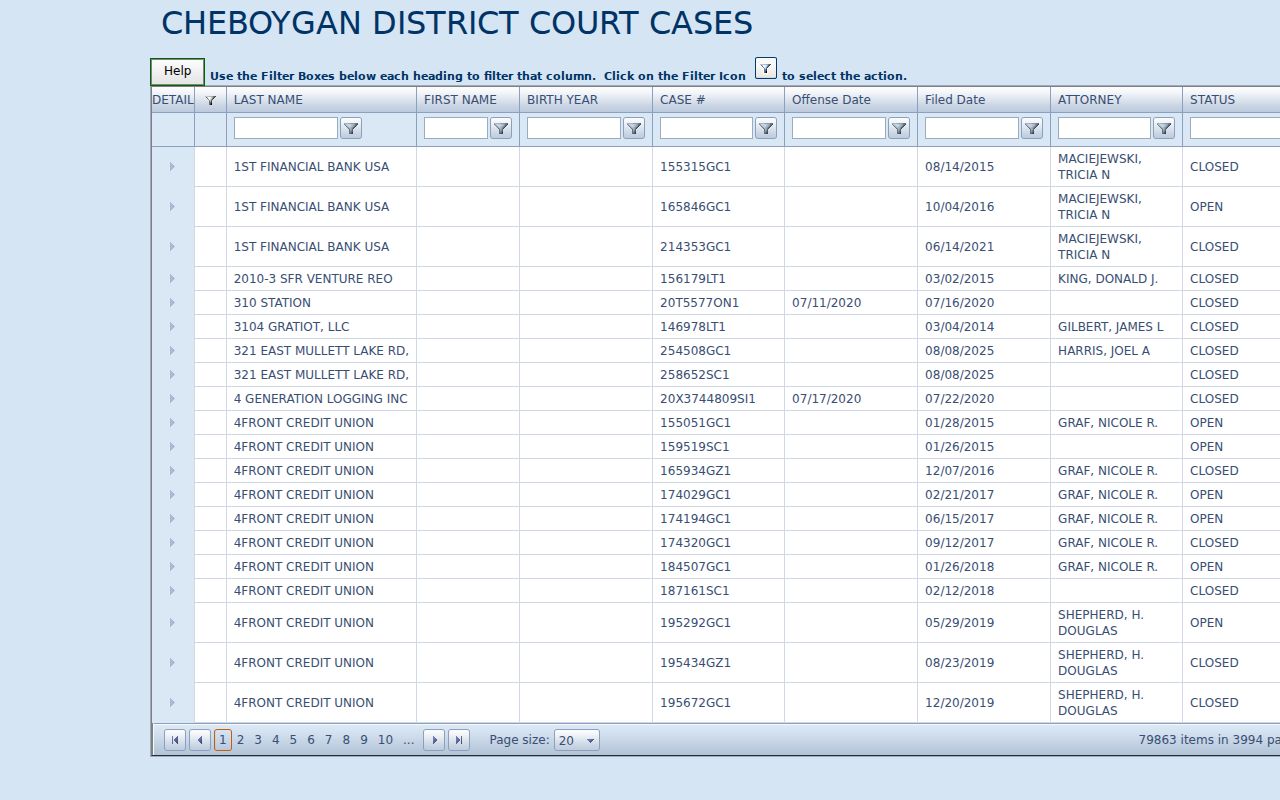
This official page shows the District Court route. Check it before a Cheboygan criminal docket search moves on to the Circuit system.
What a Criminal Docket Shows
A docket, a public index, and the court file are cousins, not twins. The 89th District portal is a searchable index. A full public case record may include more events or documents held by the court itself. MiCOURT’s field references describe court location, case type, case number, filing date, status, disposition, charges, events, hearings, and sentencing categories where they are public. Availability varies by court and by restriction.
| Case number | Use the exact local identifier, shown as the portal’s case number, including punctuation, when asking Cheboygan County staff to locate a record. |
|---|---|
| Filed and offense dates | The 89th criminal index can show both. They identify different points in a case and should not be treated as a disposition date. |
| Charge and case category | A charge is an allegation or record field. It is not a judgment, conviction, or sentence. |
| Status and events | OPEN or CLOSED, plus hearings and other events, describe the displayed case history but do not replace the governing entry or order. |
| Disposition and sentence | These later case fields can be separate from each other. A clerk can explain what public record is available for verification. |
A web record is for information only, not certified use. When you ask a clerk for a file, cite the local case number, not a made-up sample code.
Cheboygan Criminal Docket Status
An arraignment is a starting point, not a verdict. Neither a warrant nor a charge establishes a conviction either. The local criminal process can then bring a plea, a pretrial setting, trial, dismissal, sentence, or some other resolution. The 89th grid’s OPEN and CLOSED labels work the same way: they do not explain the last event or whether an obligation to the court remains. When the legal effect matters, read the disposition and the underlying order.
- Arraignment
- An early criminal appearance where the charge, rights, plea, bond, and next steps may be addressed.
- Preliminary examination
- A District Court felony probable-cause proceeding, not a final trial verdict.
- Bindover or transfer
- The move of a felony case from the 89th District Court process to the 53rd Circuit Court.
- Inactive
- A state report category that is not automatically the same thing as closed without the local record’s context.
Expand a portal row and you may see financial assessment and probation-report links. That route does not authorize access to restricted probation or treatment details. Nor does it prove a balance settles the case.
Cheboygan Criminal Status Fields
Treat the 89th District grid’s status field as one locator. It is not a complete criminal docket result. MiCOURT’s field inventory separates case status, closed date, charges, events, hearings, disposition, and sentencing categories when public. Compare those fields before concluding anything. An OPEN or CLOSED label cannot replace the court’s last entry. It cannot replace its order or a certified record either.
Stages on a Criminal Docket
A Cheboygan County felony moves through a set sequence. It starts with a reported incident and an investigation. From there the prosecutor decides whether to charge or seek a warrant. An arrest can bring the case to District Court for arraignment and bond. So can a voluntary appearance. That court then holds the preliminary examination or accepts a waiver of it. If the judge finds probable cause, the charge binds over to the 53rd Circuit Court. Pretrial work, motions, a plea or trial, and sentencing play out there. Any appeal runs on its own docket at the Michigan Court of Appeals.
Criminal docket flow: Report and Investigation › Charge or Warrant › Arraignment and Bond › Preliminary Examination or Waiver › Bindover › Circuit Pretrial › Plea or Trial › Disposition and Sentencing
The county’s criminal process explanation is the source for this local sequence.
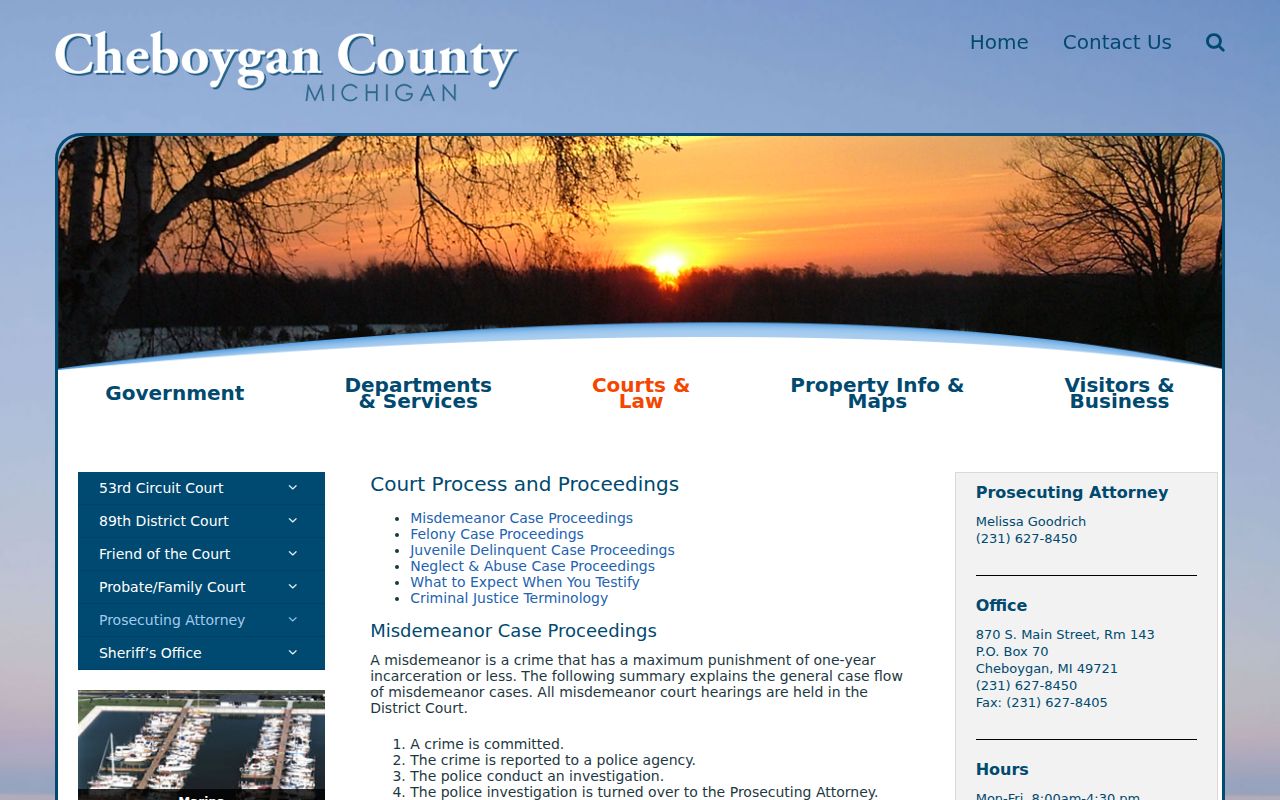
This sequence explains why one felony can leave an early District Court trace and a later Circuit Court docket. It predicts nothing about any case's result.
Cheboygan Criminal Court Access
MiCOURT warns that some courts display criminal convictions only when sentencing occurred within seven years. So a name search may miss an older Cheboygan result. Check the separate 89th portal first for a District matter. The entry may still not appear. Then a clerk request may be needed even after a careful search. Give the court, the approximate year, and case number if known.
Cheboygan Criminal Docket Transfer
One felony can show up in both Cheboygan court systems. Each entry marks a different stage. The 89th District Court handles felony complaints, warrants, bond, and preliminary examinations. The 53rd Circuit Court then holds the trial-level docket. Two results usually describe one case. Match the court and the case identifier before assuming separate proceedings. Access changes at transfer, too. For cases bound over on or after July 2, 2024, the District bindover record becomes nonpublic once the order enters. The Circuit record then succeeds it, subject to its own restrictions. The District result may vanish after a transfer. Then ask the clerk which public Circuit record can be inspected. A state appellate entry never replaces the trial-court docket.
Which Court Holds Criminal Dockets
Cheboygan County criminal matters begin at the 89th District Court. That court handles misdemeanors carrying a maximum penalty of one year or less. It covers arraignments, pleas, and bond. Misdemeanor trials, sentencing, felony complaints, warrants, and preliminary proceedings all happen there as well. Adult misdemeanor probation sits in the 89th too. For a current District case, the separate 89th public cases and calendar portals are the most useful stops. The 53rd Circuit Court handles felonies after bindover. Its public case route is MiCOURT. Meanwhile, the Cheboygan County Clerk's Office keeps the actual Circuit file. The county's 53rd Circuit page also posts live CourtDisplay schedule links for Circuit settings. Check those before attending. Federal criminal cases never enter either Michigan state docket system. Those are searched through PACER and the Eastern District of Michigan, Bay City Division.
Cheboygan Criminal Docket Programs
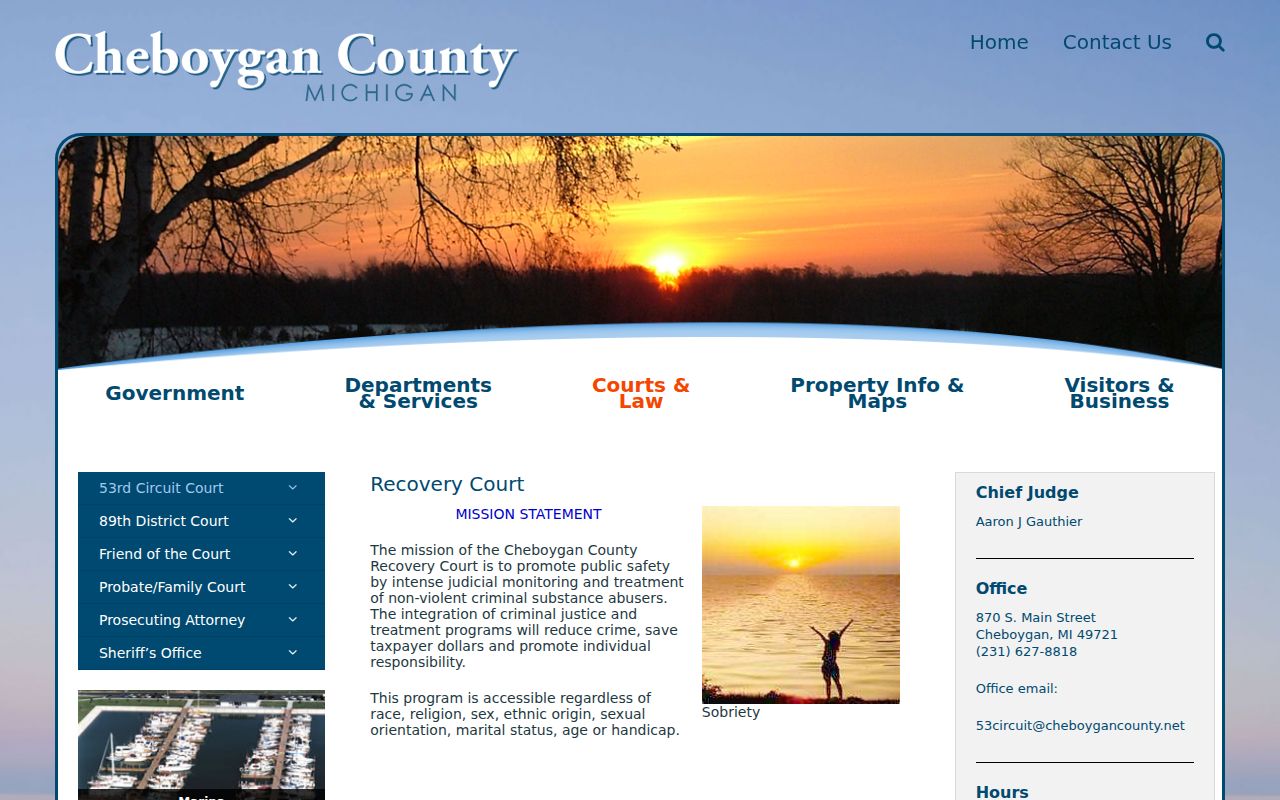
Cheboygan County runs specialty programs inside its criminal courts. The 89th District operates adult misdemeanor probation and Sobriety Court. At the 53rd Circuit, Recovery Court serves eligible nonviolent substance-abuse matters. These programs create no separate public docket system. And a court entry for a case does not make its treatment or program records public. The 89th District Sobriety Court page describes the county's program and team.
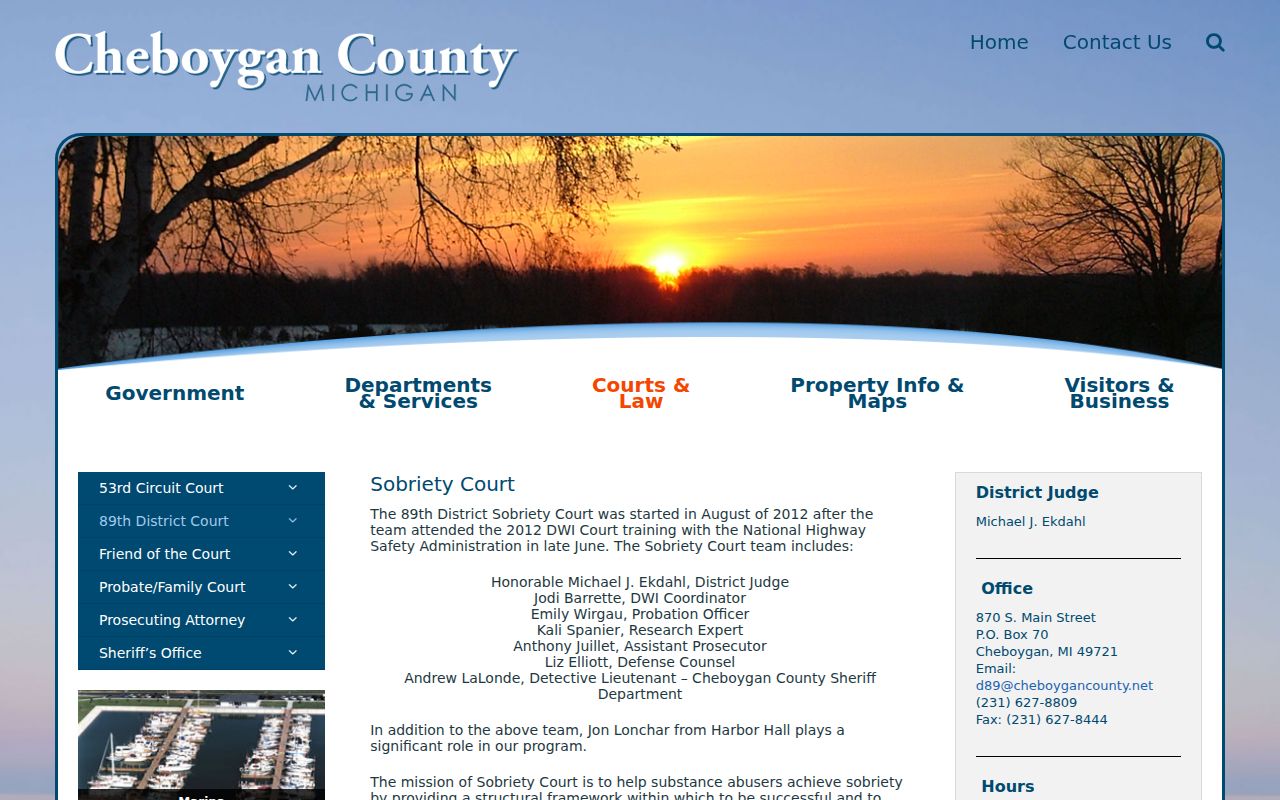
The county site can explain what a court program is. That context is not permission to seek confidential treatment information. The 53rd Circuit Recovery Court page identifies that Circuit program.
A public case lookup shows only the case information that court rules let the public inspect. Nothing more appears there.
Cheboygan Felony Docket Transfers
Start with the District side. Look for the complaint, warrant, bond, or preliminary-examination entry. Then compare the case identifier and bindover information against the Circuit proceeding. Two traces can be one case. A missing District result after bindover is not proof the matter never existed, nor that the Circuit record is unrestricted.
Public Access and Sealed Criminal Dockets
MCR 8.119 governs public access to Michigan case records. The rule generally lets any person inspect or copy a public case record. Statutes, other rules, and orders can still restrict it. Nothing in the rule makes every document, category, or portal field public. Inspection and retrieval of a public record cost nothing. The custodian may charge for copies or certification. Cheboygan County FOIA procedures reach county administrative records, not a loophole around protections on judicial records. Online case information is never the official record. Personal identifying information is protected and redacted, and what is available varies by case category, document, date, statute, rule, and order. When a public display and the official record do not match, contact the court of record.
Key rules:
MCR 8.119 governs inspection and copying of public Michigan case records, unless another authority restricts access.
MCR 1.109 addresses protected personal identifying information in court filings.
MCL 712A.28 makes juvenile records nonpublic beginning January 1, 2021, except for people with a legitimate interest under the statute.
Cheboygan Criminal Docket Workload
Cheboygan County's criminal numbers measure court workload. The county's 2025 annual report lists felony filings of 400 in 2021, 304 in 2022, 302 in 2023, 292 in 2024, and 305 in 2025. Those counts are filings, not conviction totals. The state's 2023 report tells a related story in the 89th District's aggregate table. It lists 256 bindover or transfer dispositions and 1,799 guilty plea or admission dispositions. Such labels are reporting categories. They cannot describe the history or outcome of one person's case.
Rely on the docket and court file instead. Aggregate annual-report numbers cannot tell you whether a named case is active, resolved, or restricted.